Mattress Construction & Sleep Comfort
The Perimeter Test: Why Edge Support Matters in a Luxury Mattress
A mattress can feel wonderfully supportive in the middle and still disappoint at the sides. Checking its perimeter can reveal how much of the bed is genuinely usable, whether sitting down feels steady, and how thoughtfully the mattress is built.
It is easy to judge a mattress from the most comfortable place on it: the center. That is where many shoppers lie down first, settle into a preferred position, and decide whether the surface feels welcoming. But a bed’s edges are part of its sleeping surface too. If the perimeter compresses dramatically, the mattress may feel smaller than its dimensions suggest, particularly for couples, restless sleepers, or anyone who naturally drifts toward the side.
Edge support describes how well a mattress holds its shape and provides stability near its boundary. It is not the same thing as firmness. A plush mattress can have a carefully supported perimeter, while a firm mattress may still feel unstable at the edge. The meaningful question is not simply, “Does this feel hard?” It is, “Does the surface remain reasonably consistent when my weight moves toward the side?”
In a luxury mattress, this behavior reflects the relationship between several construction details: the spring system, the border, the way the upholstery is secured, and the design of the perimeter itself. Looking at those details—and testing the bed in a few everyday positions—can help make the abstract idea of mattress edge support much easier to assess.
What edge support really means
Edge support is the mattress’s ability to resist excessive sagging or a rolling sensation near its perimeter. A supportive edge does not need to feel identical to the center, nor should every mattress feel rigid all the way around. Comfort layers often compress under body weight, and the sensation can vary according to materials, spring tension, and the sleeper’s position.
Instead, look for a controlled, predictable response. When you lie near the side, the surface should not seem to drop away abruptly or make you feel as if you must brace yourself to stay in place. When you sit on the edge, some compression is normal; the useful distinction is whether the mattress settles in a composed way or collapses so far that getting up feels awkward.
This is why a quick center-of-the-bed test can miss an important part of the experience. The perimeter is a separate zone of use, not merely a decorative border. Its behavior can affect how confidently a person moves across the bed, how comfortably a partner can occupy the outer portion, and whether sitting down to dress feels secure.
Why the perimeter affects usable sleep space
A mattress’s stated size describes its outside dimensions, but the whole surface may not feel equally available. If the edges slope, soften sharply, or feel unstable, sleepers may unconsciously move inward. That can make a generously sized bed feel more crowded than expected.
For couples, even a modest change in usable space can matter. Each sleeper may want room to shift position without feeling pushed toward the center or drawn toward the side. If one person tends to sleep near the perimeter, consistent support there may contribute to a greater sense of security. This does not guarantee better sleep or prevent every disturbance, but it can make the space feel more practical and dependable.
The effect is also relevant for people who move around during the night. A sleeper who turns, stretches, or changes positions may encounter the edge without planning to. A stable transition from the center toward the border can make the mattress feel less restrictive, while a weak perimeter can encourage a cautious, tucked-in posture.
When comparing beds, consider the full area you expect to use rather than focusing only on the middle. A simple test is to lie in your usual position close to the side, leaving enough room to do so safely. Notice whether your body feels supported and whether you can relax without shifting back toward the center. Repeat on both sides if possible: construction and feel may not be perfectly symmetrical, and a complete assessment is more useful than a single impression.
The everyday sitting test
People do not only sleep on mattresses. They sit on them to put on shoes, fold laundry, talk with a partner, or simply pause before standing. The edge is often where these small routines happen, making sitting comfort an important part of the perimeter test.
Sit near the middle of one long side, with your feet supported on the floor if the bed height allows. Pay attention to how quickly the mattress compresses and whether it feels stable beneath you. Then notice how easy it is to rise. A soft surface may sink more than a firmer one without being poorly constructed; what matters is whether that compression feels controlled and appropriate for your needs.
Try not to rely on a single brief sit. A mattress can respond differently when you sit upright than when you lie with your weight spread across a broader area. Both observations are useful, but they answer different questions. Sitting tests the way the perimeter handles concentrated pressure; lying near the edge tests how the sleep surface feels when body weight is distributed across it.
Keep the test realistic. Avoid bouncing, leaning dramatically, or using a hand to push down on the border, since those actions do not reflect ordinary use. Instead, use your normal sitting posture and transition in and out of the bed as you would at home. The goal is not to produce a dramatic demonstration, but to understand whether the mattress feels secure during familiar movements.
How construction shapes edge behavior
Perimeter support is not usually the result of one feature acting alone. A mattress’s spring unit, upholstery, border work, and finishing methods all contribute to how the edge feels. Understanding those elements can help connect a showroom impression to the construction beneath the cover.
Springs and the outer boundary
In a pocket-spring mattress, individual springs respond to pressure in their own areas, helping distribute support across the bed. At the perimeter, the way those springs are held and supported can influence whether the outer zone feels stable or noticeably different from the center. Spring count alone does not tell the whole story: the arrangement, tension, and interaction with the border matter too.
Some mattresses use additional reinforcement at the edge; others rely on a carefully integrated spring and border construction. There is no single description that proves a mattress will feel right for every sleeper. Ask what the design is intended to do, then test the result with your own body and preferred sleep position.
Border stitching and perimeter stability
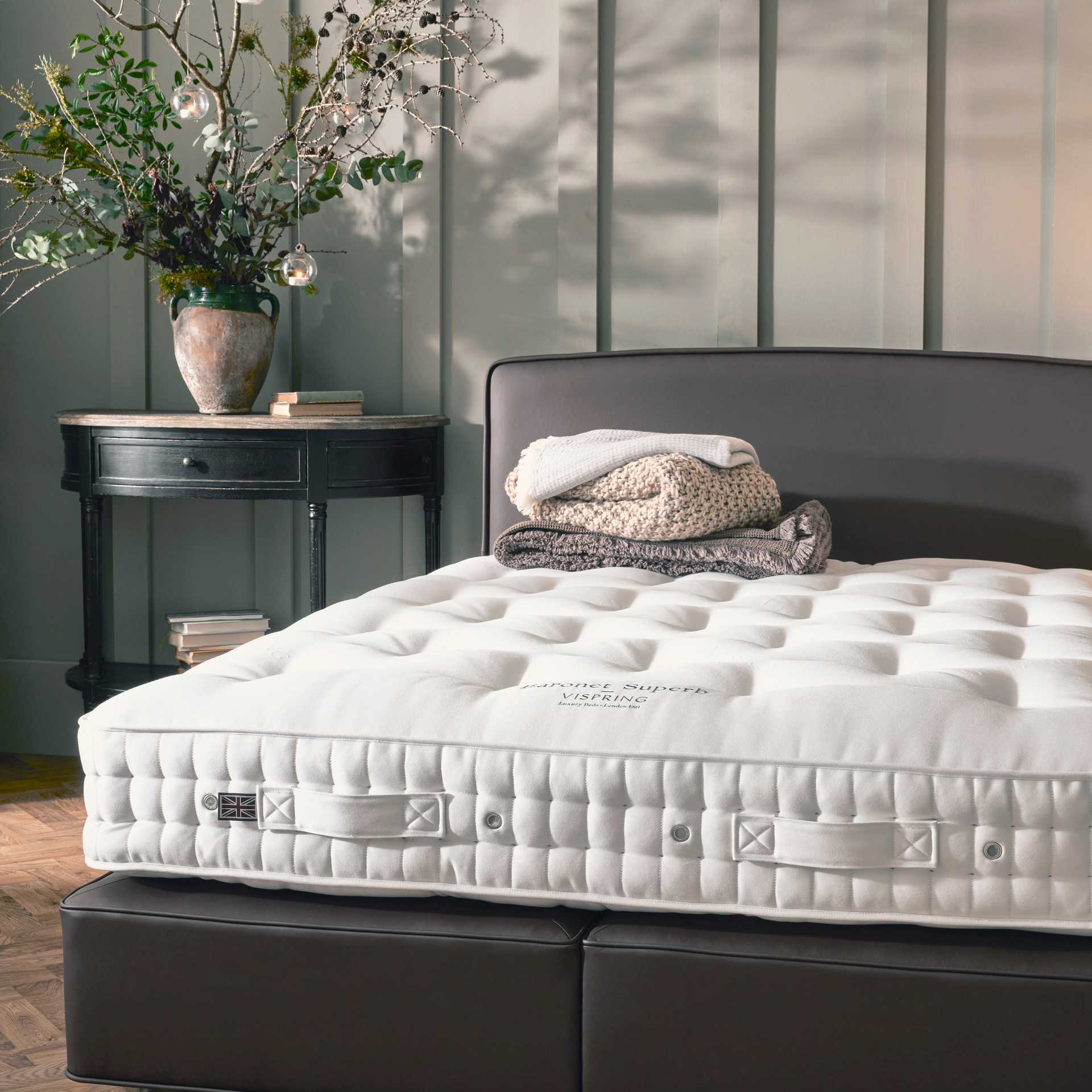
Side-stitching is a traditional method of securing the mattress border to the spring unit. By anchoring the edge, it can help maintain a defined perimeter and support the usable surface closer to the boundary. The number of rows is one visible construction detail, but it should be considered alongside the materials and the overall structure rather than treated as a guarantee of performance.
For example, the Vispring Regal Superb uses three rows of hand side-stitching, described as tying the border fabric to the perimeter springs. Its construction also includes individually pocketed Vanadium steel springs and hand-tufted upholstery. Those details make it a relevant example when examining how border work and the spring system are designed to work together. Whether its feel suits a particular sleeper still depends on personal preference and should be assessed in person where possible.
Upholstery, tufting, and shape retention
The layers above the springs affect both comfort and the way the surface settles under pressure. Natural fillings can compress as they are used, and a well-secured upholstery stack is intended to remain orderly rather than migrate or bunch. Hand tufting, for instance, draws layers together at intervals to help hold them in position. It is a construction feature to understand, not a substitute for trying the mattress.
The border may also be upholstered and stitched in ways that help the mattress retain its shape. A well-defined side can feel more composed, but the top comfort layers still matter. If the surface is very soft, it may compress substantially beneath a seated person even when the underlying perimeter is thoughtfully constructed. That response does not automatically indicate a defect; it must be interpreted in the context of the mattress’s intended feel.
A practical perimeter test for mattress shopping
Testing edge support does not require special equipment. A few deliberate observations, made in the positions you use at home, can reveal more than a quick sit or a glance at a product specification. If you are comparing several luxury mattresses, use the same routine on each one so your impressions are easier to compare.
- Lie near the edge. Move toward the perimeter in your usual sleep position. Notice whether the mattress supports you consistently or whether you feel a sudden dip or a pull toward the side.
- Change positions. Turn from your side to your back, or from your back to your side, while remaining near the edge. Look for a secure, predictable response rather than judging only the first few seconds.
- Sit as you would at home. Sit on the long edge and, if relevant to your routine, the foot of the bed. Observe how far the surface compresses and whether standing up feels comfortable.
- Compare center and perimeter. Move from the middle toward the side and notice how the support changes. A difference may be expected; the question is whether it feels acceptable to you.
- Repeat on both sides. Test each long edge if you can. This gives you a fuller sense of the bed and can be especially helpful when partners will use both sides regularly.
- Ask about the build. Find out how the spring unit, border, and upholstery are constructed. Use the explanation to guide your questions, not as a replacement for testing the feel.
Take your time. A mattress can feel different after a few minutes than it does in the first moment, and a showroom visit is still only an initial assessment. If you can, return to the edge after trying the center and your usual sleep positions. The comparison may clarify whether the perimeter is an important strength, a tolerable trade-off, or simply not suited to your preferences.
Edge support is not the same as firmness
One of the most common misunderstandings is that a firm mattress must have strong edge support. Firmness describes the overall feel of the sleeping surface, while edge support describes how the perimeter behaves under pressure. The two can influence each other, but they are not interchangeable measurements.
A mattress with a softer comfort layer may feel inviting in the center and compress more when someone sits on its edge. A firmer model may resist compression overall yet still have a perimeter that feels less secure than expected. Sleepers should consider both characteristics, along with pressure relief and alignment, rather than using one as a shortcut for the other.
Body weight, shape, and sleeping position also affect the sensation. A person who places more weight near the boundary may notice compression more readily than someone whose weight is distributed differently. The same mattress can therefore feel quite stable to one sleeper and less so to another. That difference is a reason to test personally, not a reason to assume that one person’s verdict applies to everyone.
When choosing a mattress, think about the comfort you want across the entire surface. Edge support should complement the sleeping feel, not override it. A perimeter that feels impressively firm may still be uncomfortable if the mattress does not provide suitable cushioning elsewhere.
What to consider for couples and shared beds
For two sleepers, edge support can be part of a larger conversation about space, movement, and differing preferences. A partner who sleeps close to the side may care more about the stability of that area, while someone who stays near the center may notice it less. A useful assessment accounts for both routines rather than treating the bed as a single, uniform zone.
Partners can test the mattress together. One person can lie near the perimeter while the other settles into a normal position, then switch sides. This allows each sleeper to notice the mattress under their own weight and posture. It also shows whether either person feels displaced when the bed is used in its intended way.
Some mattresses offer split firmness options in certain sizes, allowing each side to be specified at a different tension. That may address a difference in preferred firmness, but it should not be assumed to resolve every issue related to the perimeter. Ask how the chosen configuration affects the feel across the whole surface, and try the mattress in the arrangement you are considering.
Do not overlook practical details such as frame fit, mattress dimensions, and the height of the bed. A mattress that sits at a comfortable height may make sitting and standing easier regardless of the edge’s construction. The complete sleep setup—mattress, base, and room layout—shapes how the perimeter functions in daily life.
Long-term performance: what the edge can tell you
A mattress is used repeatedly in the same places. Sleepers may sit on one side each morning, get in and out from the same edge, or spend much of the night near one portion of the surface. Over time, those habits can make perimeter construction especially relevant to how the mattress feels and retains its shape.
Hand-stitching, spring design, and secured upholstery can all be part of a construction approach intended to support the border and keep the fillings in place. Still, no feature should be treated as a promise that a mattress will never change. Materials respond to use, and care, bed-frame support, household conditions, and the weight placed on the surface all play a role in performance.
Ask the retailer or manufacturer about care instructions, turning or rotation recommendations, compatible foundations, and the terms of any warranty. Follow the guidance for the particular model rather than relying on general rules: mattress designs vary, and not every product is intended to be handled in the same way. A stable bed frame with appropriate support is an important part of the system, since a mattress cannot perform as intended if its base is unsuitable.
If you notice a change in edge feel after purchase, first check the mattress placement and foundation according to the manufacturer’s instructions. Pay attention to whether the sensation is limited to one area or present around the whole perimeter. A change in feel may have several possible causes, so use the product’s care and service information before drawing conclusions about the construction.
Questions worth asking before you choose
Product descriptions often list materials and craftsmanship, but a shopper may need a little more context to understand what those details mean at the bedside. Clear, practical questions can help make an informed comparison without reducing a complicated mattress to a single number or marketing phrase.
- How is the perimeter supported, and how does that relate to the spring system?
- Does the border use side-stitching or another form of reinforcement?
- How should the edge feel when sitting compared with lying near it?
- Can the mattress be tested in the firmness or tension being considered?
- What foundation or bed frame is recommended for this model?
- What maintenance routine does the manufacturer recommend?
- Are there size or configuration options that affect the usable sleep surface?
A thoughtful answer should help you understand the construction without implying that a specification alone can predict personal comfort. If possible, follow the conversation with a hands-on test. When shopping remotely, seek precise descriptions, verify dimensions and compatibility, and review the seller’s policies before ordering.
The takeaway: test the whole mattress
The center of a mattress may make the first impression, but the perimeter can determine how much of the bed feels genuinely comfortable and dependable. Good edge support can contribute to a more usable sleep surface, a steadier place to sit, and a more confident feeling when moving near the side. Its value is especially apparent for couples, people who use the full width of the bed, and anyone whose daily routine includes sitting on the edge.
Look beyond firmness and focus on the way the mattress responds. Lie near the side, shift position, sit normally, and compare the edge with the center. Then connect that experience to construction details such as the spring system, border stitching, and how the upholstery is held in place.
There is no universal edge feel that suits every sleeper. The best choice is the one that offers the combination of cushioning, support, and perimeter stability you can use comfortably. A careful perimeter test turns a detail that is easy to overlook into a practical part of choosing a luxury mattress.